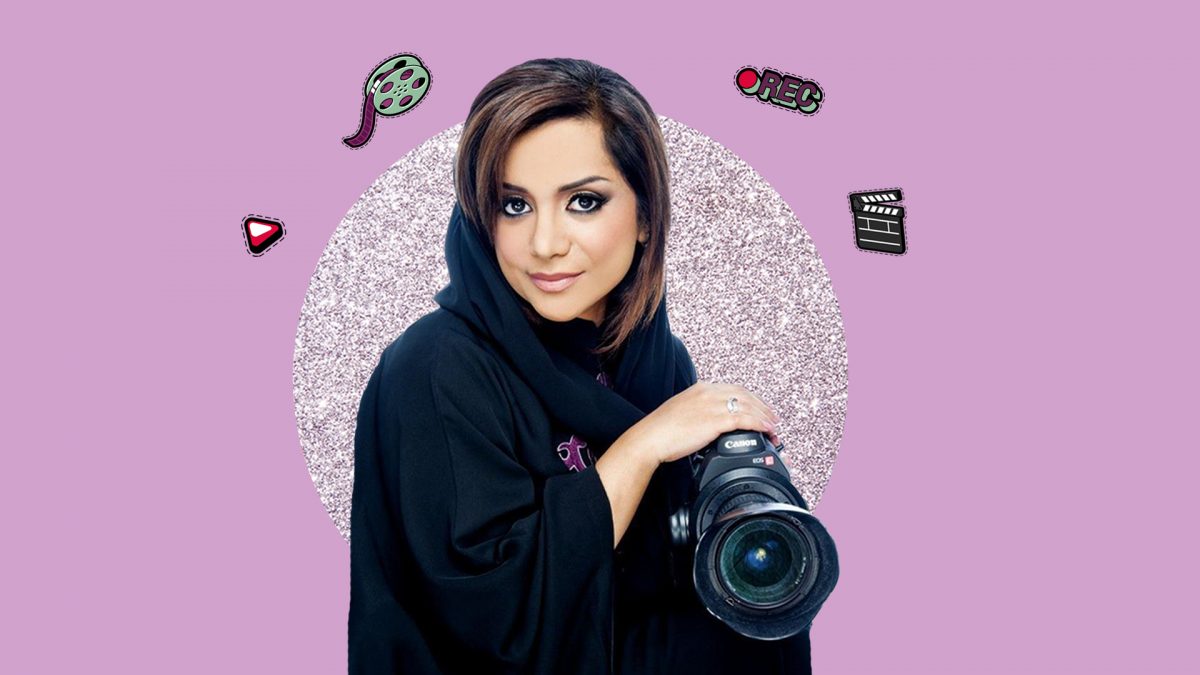

Nayla Al Khaja is one of the Arab world’s most prolific auteurs, toggling between documentaries (“Unveiling Dubai”), films (“Malal”, “Once”, and “Animal”), and television ads (“TV commercials they are my main bread and butter… you can’t really depend on a feature film to stay afloat”). She fell into filmmaking 20 years ago, and has emerged as a uniquely voiced writer-director-producer, now helming her own eponymous production company Nayla Al Khaja Films.
“I’m a painter,” she starts. “My background is oil on canvas. One day I noticed something interesting: when I looked at my canvases, they were all as if someone had paused a moment, like, paused a scene in a movie. I accidentally stumbled into filmmaking at the age of 19 and absolutely fell in love with it, because I felt that it gave me what art couldn’t: energy. Filmmaking still has all the artistic elements (composition, lighting, photography, negative and positive spaces), but with filmmaking you’re working with up to 100 people on set. Now, I get to see my pictures come to life – hence the term ‘motion pictures’.’
Nayla, born and bred in the UAE, grew up in Dubai at a time when filmmaking didn’t really exist. “When I graduated from school 25 years ago, there was nothing in the Middle East for fine arts; no courses or universities. So, I applied to Ryerson University in Toronto, Canada, and studied cinema and fine arts there for four years. When I came back to the UAE afterwards, I started my little business.” Nayla was among the small group of women in the region doing a man’s job, but her enduring perseverance, tenacity and talent stood up in its own right and has seen her emerge as one of the most trail-blazing women of her generation.
“I remember when I came back from Toronto and I made my first documentary here [in the UAE], I had to literally fly people in and fly equipment in,” she recalls. “It was so expensive because there was no proper infrastructure for filmmaking, so everything was like pulling teeth. I had to create something from nothing.”
In an industry where a feminine point of view continues to be devalued, Nayla praises other female peers for proving themselves on a man’s turf. “Nadine Labaki is basically my role model. Everything that she has achieved is amazing. Arab women are still portrayed as people who are oppressed, without a voice, who don’t have freedom, so I can’t even tell you how important it is that our voices are heard. Imagine if an Arab female director directed the next Wonder Woman, that would shatter every glass ceiling. There is nobody who has reached that level yet, though, so I am really hoping to be able to have that kind of impact and inspire younger girls and boys to be able to pursue this path.”
“I am also really inspired by Butheina Kazim. She is not a female director, but she is the founder of Cinema Akil, which is as important as being a director, because she is the platform where our films can have the limelight, She is the only arts house owner in the UAE where films that are non-Hollywood and non-studio get a chance to see the light of the day.”
Industry leaders like Nalya have become a rallying call for women everywhere and a beacon of empowerment for Arab woman in man’s world. “At the moment, women stand at 9% published work worldwide, it is ridiculous,” she says. “It is very male-dominated, so as a woman you have to have such thick skin, and such a firm voice to stand out. It’s so hard. I had to work three times harder than my male counterparts, because it’s such a male-driven industry.”
Even so, she thinks it’s important to mentor other women as they try to climb the industry ladder. “My advice to young women would be: dare to ask production houses to volunteer, go and take part, volunteer. You need to have the mindset that you never stop learning. The minute you think you know it all, you are dead in the water. You have to keep telling yourself there’s so much more to know and so much more to learn. Even go right back to the basics sometimes.”
On top of the obvious intellect and professional shrewdness Nayla exudes in the film industry, the 42-year-old has also recently been named an ambassador for Porsche. “Film is so mobile,” she says. “It is such a fluid medium. I can travel anywhere in the world and make a movie, which is why lies parallel with my work with Porsche, it’s that whole idea of travelling, journeys and empowerment.”
“Porsche was my first dream car, by the way,” adds Nayla. “It was on my bucket list and I promised myself that when I turned 33 I would buy one. I knew I couldn’t afford one, so I told myself I better work really hard! When I turned 33 I was crazy, I actually went to the showroom and I bought my Porsche. That was such an amazing feeling.”
Nayla Al Khaja’s eclectic directorial taste leaves little sense of where her tastes might drift to next – though she has one dream genre on her wish-list you wouldn’t necessarily guess: horror. “I love, love, love suspense. Horror has seven different genres within it, but I love psychological horror and suspense – anything that is dark, gritty and rough. It’s ironic because it’s usually referred to as masculine work, but a lot of people don’t know that American Psycho was directed by a woman.”
“I would love to work with Stanley Tucci and Daniel Day-Lewis. I don’t really care much for special effects, for me, the story is really important and it’s all about the complexity of my characters. Horror movies remind me of Renaissance paintings: moody and atmospheric. That’s probably why I like them so much, because they fulfil the artist in me. One day I will be known for films that have everything to do with being dark, mark by words.”
As for what else 2021 holds for the Emirati pioneer, “I am working on two projects at the moment: one as an executive producer, and one a series with a really well-known writer, which I can’t disclose, because I signed an NDA,” she teases. “But 2020 taught me a lot of things, like not to be impulsive and not to rush. I know the quality of my worth and how to be flexible without compromising. It’s hard to navigate between both, but there is a beautiful line in the middle that you can learn how to walk on.”