
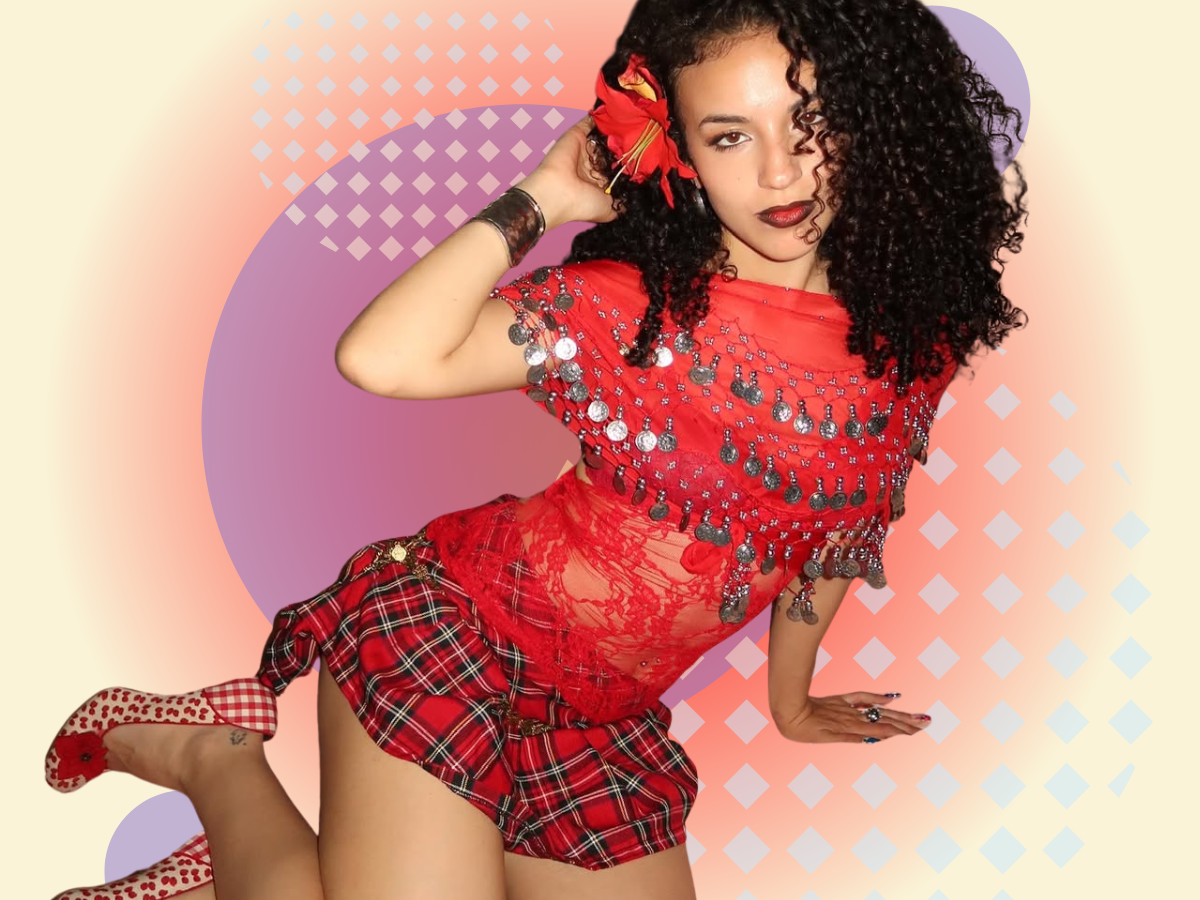
As a Moroccan–Italian woman born and raised in New York City, I learnt early that being a woman is a performance. How I walk, how I talk, how I wear my curls – there will always be someone watching, judging, or scrutinising. Growing up between cultures, I saw how this gaze took on different forms – through Moroccan hshooma (shame) culture, American advertising, and family expectations. Women are often fed the same story: that our bodies and our pleasure exist at the hands of someone else’s control.
A night in Casablanca
Last summer, my father and I went to Morocco to visit family. One night, he insisted we go see a belly dancer perform at a restaurant in Casablanca. I was eager – I had only ever seen snippets of belly dancing in Morocco, usually in places where French tourists eat while on their vacances, or in films. Most of the guests here were businessmen with loosened ties and wine glasses, the chandelier was massive, and the waiters dressed in fezzes and suits.
We ordered, and the music began. The belly dancer entered, wearing a tight two-piece bra-and-skirt ensemble, decorated with dozens of green jewels that chimed with every step she took. Her hair and make-up were perfect. She smiled wide as she danced, making eye contact with every single person in the room. I was in awe; she was the physical epitome of divine femininity. But I was taken aback when I realised she didn’t visibly look Middle Eastern or North African – she was white. “Moroccan girls don’t really do that, Zina,” my dad said. I asked him why, and he shrugged his shoulders. I later learnt the dancer was Portuguese, having moved to Morocco to seek more belly dancing opportunities.
The hypocrisy of shame
There was this one businessman in particular who I watched; indulging in the pleasure of the spectacle before him. But when I made eye contact with him, his eyes immediately dropped to the floor in shame. In a country where public modesty is expected, inside these walls, a foreign woman could embody a traditional North African art form for the sake of pleasure and entertainment – while a Moroccan woman would be judged and stigmatised for embracing her culture’s past tradition.
Belly dance was historically a sacred ritual where women gathered to celebrate fertility, womanhood, and storytelling. But in the 19th century, the orientalist gaze distorted this tradition, turning North African women into objects of sexual fantasy for European audiences. This colonial lens stripped belly dance – and, by extension, women’s agency – of its original meaning and freedom.
Reclaiming the lens
My self-portrait series, THE SPECTACLE IS A WOMAN (لفراجة مرأة), is both a personal and cultural reclamation. Inspired by early 20th-century Moroccan postcards – many taken by French photographers – I explore the tension between empowerment and judgement, dissecting what it means to exist unapologetically in the spotlight while navigating the gaze, expectations, and contradictions placed upon women across the MENA region and its diaspora. In these images, the belly dancer is a martyr; she represents the woman who refuses to take no for an answer. I stand without shame. I wear my curls as big as I want. I hold beauty and divinity in the freedom of my being.
Today, our communities carry an internalised, colonised hypocrisy toward belly dance – condemning it as indecent while simultaneously indulging in its spectacle. Time and time again, this relationship with the North African woman’s body is stripped from our control, a direct result of exoticisation. The resulting shame pressures us to shrink, to censor ourselves, to exist only in ways deemed culturally “acceptable.” The North African woman then becomes the forbidden fruit – desired by all, yet perpetually off-limits.
Resistance is to exist fully as we are – raw, unapologetic, and feminine on our own terms. To push back against the control imposed by the patriarchy, we must continue to honour our traditions: henna with our girlfriends, belly dancing nights, and dressing as we choose. THE SPECTACLE IS A WOMAN (لفراجة مرأة) is my declaration that women will exist fully – unbound in our humanity and our femininity. Through my project and beyond, I fight to reclaim that space. This body is mine. This joy is mine. This freedom is mine. No one can take it away from me.
Check out these Moroccan content creators you need on your feed!