
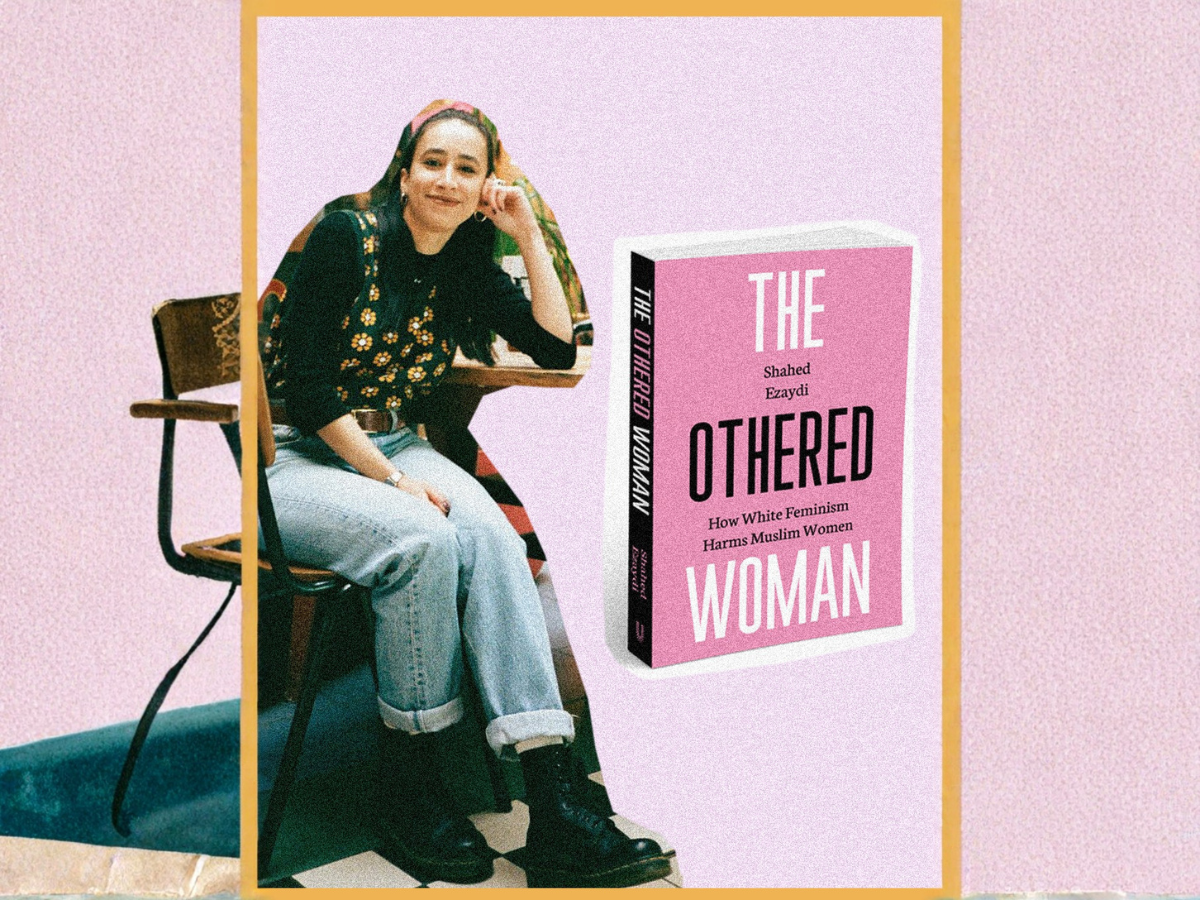
Growing up between two cultures, navigating Islamophobia whilst trying to make sense of her own faith and identity, Shahed Ezaydi found herself in a place many young Muslim women will recognise: caught between worlds, with no book on the shelf that truly spoke to her experience. That book, it turns out, she would have to write herself. The Othered Woman is the result of years of unlearning, research and radical honesty.
At its core, the book is a rigorous and deeply personal dismantling of what Ezaydi calls white or liberal feminism: a strain of feminist thought that centres the white middle-class experience and treats Islam as the primary source of oppression for Muslim women, whilst ignoring the layered, intersectional realities they actually live. We chat with the author to unpack her thesis and writing process.
Cosmo ME: Why did you feel compelled to write The Othered Woman? How does it relate to your personal life and identity as an Arab woman?
Shahed: Growing up, I was often asked how I could call myself a feminist and still practise my faith. Dealing with Islamophobia, while also trying to navigate the two cultures I was growing up with, left me feeling pretty lost. My friends didn’t really get me, and I was too nervous to talk to my parents about my confusion, as I didn’t want them to think I was rejecting our way of life. But constantly being told things about your religion, especially when it comes to women’s rights, meant I started to absorb some of it and believe in this Islamophobia.
In my mind, feminism and my faith became two distinctly separate entities, existing on opposite sides of my sense of self. But something didn’t feel right about it all, and so I decided to do my own homework. I spent most of my early 20s sifting through books, academic journals, video essays and newspapers; gaining a deeper understanding of feminism, Islam and myself.
The Othered Woman is the book I wish I had access to when I was a young teenage girl. It challenges the myths of how Muslim women are oppressed and who by, and shows that these myths translate into very real harm both in Britain and around the world, showcasing the voices of intersectional feminists who are fighting for liberation on their own terms.
Cosmo ME: Can you synthesise the thesis of your book?
Shahed: The Othered Woman is an exploration and interrogation of white Western feminism and how its approach to gender inequality and women’s liberation is harmful to Muslim women. White or liberal feminism refers to a type of feminism that focuses exclusively on white middle-class women and prioritises individual power over collective liberation. It assumes that white women experience misogyny in the same way all women experience misogyny, which is simply not the case.
In the book, I explore themes such as the concept of single-issue oppression, where white feminists are unable or unwilling to consider the other forms of structural barriers that impact Muslims, and view Islam as the primary and only source of oppression. I also look into the politics surrounding the hijab and how it has become the symbol of oppression for Muslim women, based on the belief that a veiled Muslim woman doesn’t fit into what white feminism views as a ‘liberated’ or ‘modern’ woman. Additionally, the misogyny of Muslim men is examined, as white feminism has also pushed the narrative that the misogyny of Muslim men is inherently different or worse than that of any other.
However, even though the book focuses on painful and heartbreaking experiences, it concludes on a more hopeful note, where I showcase the brilliance of Muslim women – past and present. It isn’t an attempt to prove our worth or our contributions but simply to shine a light on our own feminist history.
Cosmo ME: What are your hopes for people reading this text?
Shahed: I want this book to serve as a foundation and a tool to both gain a better insight into the insidious nature of white feminism and to learn more about the lives and experiences of Muslim women across the world. If a reader learns something new about Muslim women or can think more critically about feminism in the Western world, or a reader is able to relate to the text and have their own experiences validated, then I’ll feel as though I’ve done my job right.
Cosmo ME: How are people responding to the book?
Shahed: Positively, so far! I’ve been blown away with the response from readers and people who have attended the events on my book tour, who have read, shared and engaged with The Othered Woman. This isn’t to say that there hasn’t been some negative online trolling, but, sadly, that’s become a part and parcel of my work as a Muslim woman working in journalism and publishing.
Cosmo ME: What are some beauties and challenges of being an author?
Shahed: I consider it a huge privilege to be an author and to have a book like The Othered Woman be published. Reading is such an integral part of my life, and I truly believe books are powerful tools for change, action and solidarity. It’s how we learn about the world and each other. So, to be an author and have people pick up and read my book is a beautiful thing that I’m so proud of.
For me, the main challenge of publishing a book came after the writing process. This isn’t to say that the writing process was always easy (writer’s block was very real), but I found the commercial element of selling and promoting a book a little more difficult. I’ve struggled with imposter syndrome for a lot of my career, and this became quite prominent in the weeks leading up to the book’s release date. However, it was a learning curve as a debut author, and through these difficulties, I found community with other female authors whom I now call dear friends.
Read Cool South Asians Are Everywhere next!