
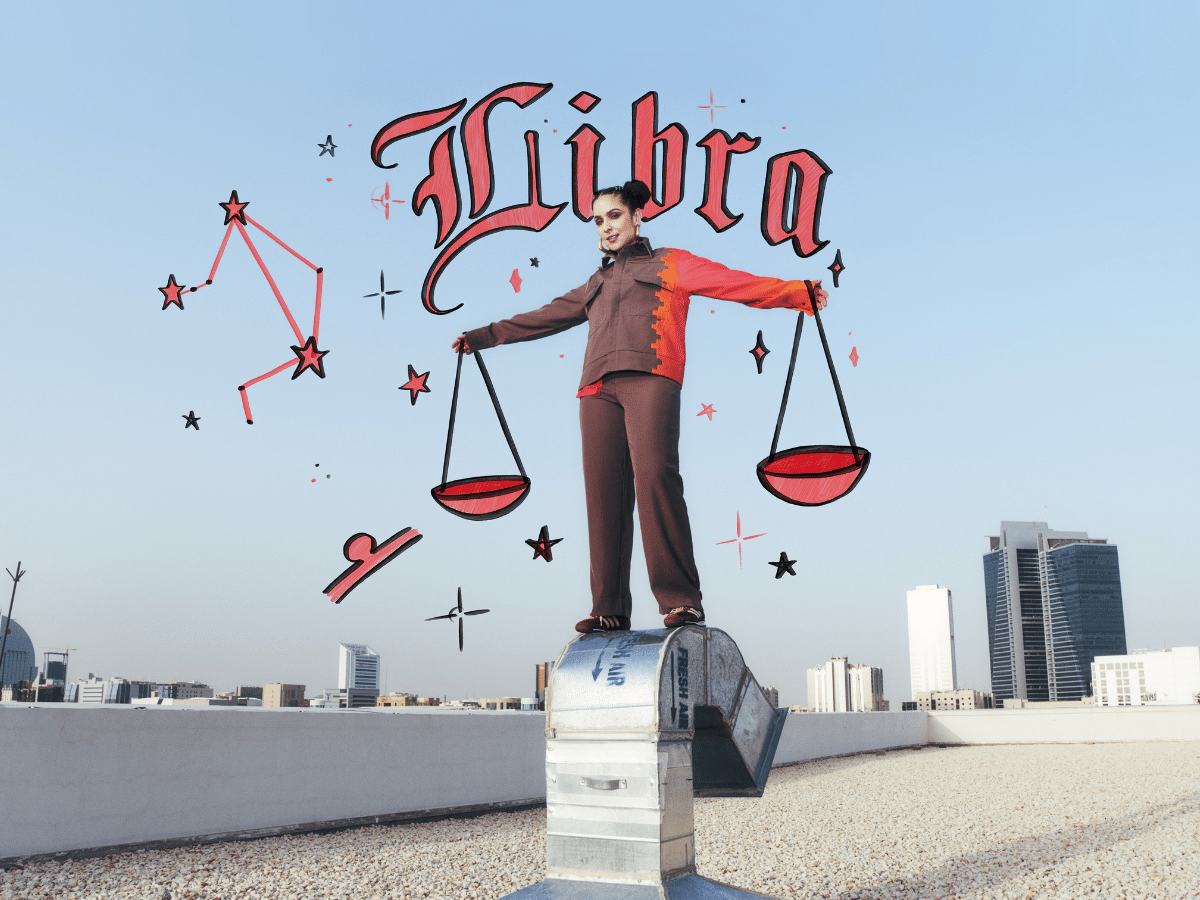

In her signature space buns and technicolour co-ords, Laughta is appropriately dressed for her Cosmo cover shoot. Her bubbly personality and enthusiasm are infectious; her vibe proves itself to be nothing if not authentic.
We manage to pin her down for her interview mid-studio session, where she’s busy making new music in Riyadh – a place, she says, she has become “addicted” to. It’s near impossible not to get swept up in the love she has for her craft. “I want to inspire the younger generation of Arab women – particularly Arab women in the UK, because I know first- hand how it can feel like we don’t belong in the music industry,” she tells me. “But really I just want to inspire anyone that has music in them. I want all women who may not think they’re good enough to see that if I can do it, they can do it.”
Fresh off a year of musical success taking home BBC Introducing’s ‘One to Watch’ award at the 2023 AIM Awards, and becoming the first ‘Artist in Residence’ at The Saudi Music Hub, Riyadh, Laughta subsequently scored herself a signing with MDLBEAST Records, where she is soon to release her first EP with the Saudi music label.
The British-Lebanese artist is unabashedly herself on her record. Think lovably blunt English-Arabic rap lyrics that will hit you right in your feels, and a dance-based production peppered with Middle Eastern riffs and percussion. Laughta weaves her internal struggles
into her music and is all the more empowered by it. “I touch on deep topics in a lighthearted way,” she says. “I write lyrics that are quirky but still go hard. I’m still saying stuff that will hit you in the chest, like, ‘woah, she said that?’, but I try and deliver it in a subtle, very versatile way. I’m a Libra! We’re straight to the point. With me there’s no lies being told.”
In the spirit of honesty, the rapper-producer opens up about her struggles as an immigrant moving from Nigeria to London with her Lebanese family, her rise to fame, and reclaiming her Arab roots within her songs. But Laughta’s ultimate mission is clear: she’s setting out to change the trajectory of women in music. Her goal to spark nuanced conversations around gender equality in grime and rap is something that’s even more powerful than a chart-topping track.

Jacket: Kith at Ounass
Top: The Giving Movement
Earrings & bracelet: Swarovski
Jeans: Good American at Ounass
Next page: Jacket: Les Benjamins
Cover story: Laughta is the best medicine
Cosmo ME: How did the name Laughta come about?
Laughta: Where I grew up everyone had tag names embroidered on our jackets and one of my friends actually called me Laughta because I just laughed all the time, and my laugh was super loud and mischievous. You could hear it from a mile away and know it was me. I even won ‘Best Laugh’ at school.
Cosmo ME: Laughta by name, Laughta by nature!
Laughta: I really laugh a lot; it’s good for the spirit, good for the heart,good for the soul, and it makes everyone else smile, too.
Cosmo ME: Were you always the entertainer when you were growing up?
Laughta: I was always an extrovert. I played basketball religiously at school, so I grew up on the court around a live audience, and I was in all the school plays. Performing felt natural to me, and when I was living in Nigeria at about six-years-old, I won a singing competition and a lunchbox as the prize. I was buzzing to win that lunchbox.
Cosmo ME: What was it like growing up in Nigeria?
Laughta: I was born in Nigeria in Kano State – there’s a huge Lebanese community there. We lived there ‘til I was about seven-years-old until my family decided to move to London. So I went from having a really stable, strong foundation to moving into a council estate in the UK, which was a bit rough, but this is where I discovered grime music. I used to watch the older generation battle each other, or MC over a beat in the alleyway and was so inspired by it that I started writing my own lyrics. I then graduated with a degree in psychology, and became the first person in my family to get a degree.
I was so proud of myself, I even went on to teach for a little bit whilst doing music on the side. Whenever I had time I was doing showcases, putting on music events, emceeing – anything. As I got deeper into the industry, I recognised the gender gap and how many male acts were being booked over women, so I started an event called Female Hype, which is where I met my now-manager, Nadia. I wanted to spotlight women in the music industry, and the events were super successful, but I really wanted to focus on my own music, too.
Cosmo ME: So you were born in Nigeria, grew up in London, but your parents are both Lebanese… Talk about being a third-culture kid!
Laughta: That’s the beautiful thing when talking about identity: you take from everything because it moulds you into who you are. I’m Arab by heritage, British by culture, and I’ve also got a very strong relationship with Nigeria because of my early years there. I absolutely loved it there, the food, the Afrobeats… Ultimately I’m an Arab, but I’m really happy I’ve been able to experience and be part of different cultures, because it made me who I am.

Jacket: Kith at Ounass
Top: The Giving Movement
Earrings & bracelet: Swarovski
Jeans: Good American at Ounass
Shoes: Laughta’s own
Cosmo ME: How have you stayed in touch with your Arab roots all these years?
Laughta: Definitely through music. My older sister always played popular Arabic songs when we were growing up. My dad was friends with Salah Alzadjali as well, so I used to get live performances when he came to our house.
Cosmo ME: Have you ever felt the pressure to conform to the mainstream in your music?
Laughta: Absolutely. About four years ago when I first decided to give music a go, I felt a lot of pressure as a woman in this industry because we are judged by our image first. We’re either not pretty or sexy enough, or we’re over sexualising ourselves. It’s exhausting to feel like you have to look good all the time, especially when men in the music industry are not held to the same standards. I still have intrusive thoughts, like, am I girly enough? Should I wear my hair down more?
When I look at the most successful female artists, I look nothing like them. But I’ve always been a strong advocate for being true to your most authentic self. And when it comes to the music, I definitely felt suppressed by my Arabic roots at the beginning. I didn’t use Arabic in any of my songs because of the racism that was going around in the UK at the time, and I felt pressured to create what was deemed ‘cool’, which was English hard rap. But now I don’t go into the studio worrying about what everyone else wants to hear. Ever since I’ve tapped into my Arab roots, my music is at its purest and most authentic form. It feels so liberating as an artist and a human to create songs that feel raw.

Jacket & shoes: Adidas
Top: Casablanca at Ounass
Sunglasses: Gucci
Jeans: Marques Almeida at Ounass
Cosmo ME: How did the Artist is Residence program happen?
Laughta: In May 2023, I was invited by the Saudi Music Commission’s CEO, Paul Pacifico, to be the first artist in residence at The Saudi Music Hub, Riyadh. I was given the opportunity to spend a whole month at their music studios in Riyadh, creating new music and collaborating with local artists. The Music Hub is such a beautiful space where I’ve been able to freely create day and night. The collaboration has received incredible support from MDLBEAST, Anghami, and Apple Music. I’ve had my music played across Arab countries and in the UK on BBC Radio 1 and BBC Introducing. I’ve even had my music video with Mohammad Al Sahli for ‘Leila’ played on Arabic TV channels! Working with the Music Commission has completely transformed my creativity; it’s been such an unforgettable experience so far.
Cosmo ME: What have been some of the best things about collaborating with the Saudi and Arabic artists you’ve been working with?
Laughta: There’s just such a wide range of talent here in Saudi. I can’t pinpoint one style that exists here, and that’s so exciting for me as a producer. It’s penetrated my creativity on a deeper level and opened me up to a whole new range of styles, sounds, and a fusion of Arabic and English, which has really inspired me in my own EP. Sonically I’ve incorporated a lot of Arabic percussion into my music, and I’ve been lucky to have worked with the Saudi National Orchestra at Paris Fashion Week. Being able to incorporate instruments like the oud and sounds like the tabla has been amazing. As a Lebanese, we like to shake our hips, so when we hear the tabla and you see it all live on stage with percussion, it’s absolutely magical.
Cosmo ME: Wow, how amazing that your work is catapulting Saudi’s music scene onto a global stage.
Laughta: As soon as we performed in Paris, the feedback was incredible. We had people coming up to us all night. It was described as “edgy” and “very different” and “really exciting”, which, to me, is exactly what music is. It’s a form of art. I’m a British girl from London and Lebanon, and to be rapping and doing something so quirky with Saudi National Orchestra in front of a UK audience was so powerful.

Jacket & trousers:
Les Benjamins
Top: Lacoste
Shoes: New Balance
Cosmo ME: This might be like asking someone if they have a favourite child, but do you have a favourite track on the new EP?
Laughta: Every single one is beautiful and I love all of them. Something I’ve never done before was create a style with this Sudanese artist who loves reggae. He’s from Saudi and his name is A.G Nimeri. I first heard his vocals in a song called “Hinak Hina”, and then I met him at The Saudi Music Hub, Riyadh, I said ‘lets go to the studio!’ I’ll never forget that night: in that moment it just became all about the music. I also worked with an artist called Nora, who is a member of an all-female rock band here in Saudi. So the variety of songs on my EP just makes it all so unique.
Cosmo ME: And aside from the music what else are you loving about spending so much time in Saudi?
Laughta: I just feel at peace. I don’t feel the same stress as I do in the UK. Here I am able to have moments of calmness and stillness. I’ve got all my friends, the buildings are beautiful, the food is absolutely delicious, and the people are so lovely. I also love that I can go to the studio at 10 p.m and feel safe.

Top: Gauge81 at
THAT Concept Store
Trousers: Les Benjamins
Earrings & ring: Swarovski
Cosmo ME: So many people say they feel safe in the Middle East.
Laughta: It’s a real passion of mine. One day I’d love to open up studios that are safe spaces for women. Don’t get me wrong, I’m not trying to ostracise the men. In fact, I would love to involve them somehow, but I really want to create a space for women to come and express themselves musically. There may be a lot of women who don’t have the finances for studio equipment, so I want to offer that.
Cosmo ME: Sounds like you’ve got a pretty good 10-year plan!
Laughta: It comes from the heart. It’s always in the back of my mind to do something like that. Imagine a Laughta Studio where women can come and book it out for free. Like a musical non-profit where they can just develop their talent, because I know how limiting it can be without any of the resources. I’ve been there myself. Learning and feeling safe should be not just accessible, but a priority. I want women to boss it up.
Cosmo ME: Would you say that, ultimately, that’s what you want your legacy to be?
Laughta: That’s such a beautiful and intense question, both at once. In terms of my legacy, I also want to give back to other countries, like Palestine, Syria, Lebanon, and Riyadh. And I want to be remembered for spreading more of my Arabic fusion sound worldwide. I’d also love to perform in more Arab countries like Lebanon, and further connect with my roots.
Words and interview by Milli Midwood
Photographer: Mattia Guolo
Styling: Imogene Legrand
Illustrations: Antonio Pelus
Senior Producer: Steff Hawker
Makeup: Daad Aldahami
Hair stylist: Ferdose Mohammed
Styling Assistant: Florence Webber
Photography Assistant: Alessio Spanu
Special thanks to The Saudi Music Hub, Riyadh