
In Bengali culture, a daak naam is an intimate calling name reserved for close circles like family and friends. It’s often tender and distinctly separate from the bhalo naam, the formal name used for official and public purposes. The Japanese proverb Mitsu no kao tells us that every person has three faces: the public face, the private face shown to family and friends, and the innermost face seen only by oneself. In many Arab cultures, names, often drawn from the Quran, carry the weight of collective identity. The ubiquity of names like ‘Mohammed’ reflects a shared heritage, and it’s not uncommon for people to be addressed by their surname instead.
Across the world, names hold meaning tied to lineage, faith, and identity.
Artists understand this deeply. For them, a stage name is more than branding; it’s the birth of a new persona. An alter ego can move through spaces that their given name might never be allowed to enter.
The alter ego is born
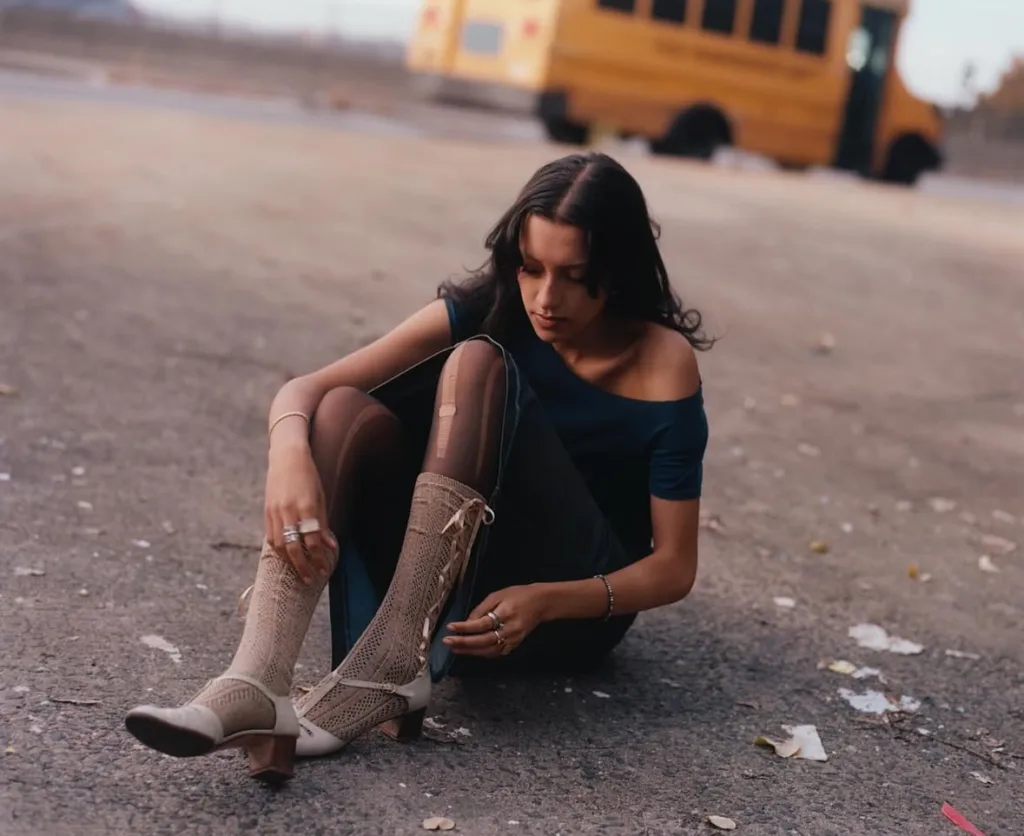
For Bengali-Canadian artist SuKha Never Dies, who grew up in Saudi Arabia, that alter ego is as real as it is mythical. With dramatic eyeliner and a hijabi presence that bends aesthetic codes, her image doesn’t merely exist—it declares. “My alter ego is allowed to break societal norms and critique it,” says SuKha. “The alter-ego doesn’t have anyone to impress or anyone to look down upon her. My alter-ego is an expression of a fantasy come to life. This directly influences what I say, how I perform and what I choose to create and wear.”
SuKha is the social face, the one who code-switches between spaces and adapts to her environments. SuKha Never Dies is different. “SuKha Never Dies can’t be bothered by people’s opinions or their concepts of beauty or what’s acceptable because if she allows that to seep in, then the entire persona is gonna fall apart,” says SuKha. “SuKha Never Dies has to exist as this otherworldly dimensional being you can’t touch, whereas SuKha is someone you can touch and interact with.”
Even though SuKha Never Dies stands entirely on her own, she’s rooted in Sukha’s reality. SuKha’s alter ego was born from a lifelong experience of rejection. In her childhood, she was excluded from Saudi institutions and culture due to her non-Saudi identity. Growing up in compounds and private schools, disconnected from both Arabic and full belonging, she navigated a fragmented sense of home and self. After immigrating to Canada, she experienced Islamophobic bullying. The compounded displacement and dismissal only crystallised into resilience. She turned to experimental fashion and music to reclaim her narrative.
The alter ego is about freedom
The alter ego is driven by peak freedom. “It comes in and out from a place of desire, a desire of whatever feeling we want to create for ourselves” says Tasneem Sarkez, a Libyan artist based in New York. Tasneem began creating art under the alias “Zekras,” a playful inversion of her last name. While most people know her as Neem, her artistic identity is now rooted in her full name. It’s a deliberate choice shaped by the themes of identity, cultural memory, and Arab modernity that run through her work. For Tasneem, grounding her practice in her full name changed how she views the world, deepening her connection to her background while leaving space for personal truth. In turn, it allows Neem to carry life a little more lightly, while the art remains the serious work.
“Alter egos aren’t necessarily oppositional,” says Tasneem. “I think everyone has some sort of alter ego whether it has a label or not.” The ability to shift between selves depending on space, gaze, or intent is a universal experience. Today, where a racialised image is often a symbol or representation of a larger culture, people of colour constantly negotiate how to present in order to protect their sense of self, according to Tasneem. The alter ego becomes less of a mask and more of a mechanism shaped by the need to survive systems.
The alter ego is a universal experience
Despite SuKha’s and Tasneem’s different geographies and disciplines, both rely on alter egos to express themselves. Their alter egos are tools that allow the artists to play in freedom, fantasy, and truth.
Whether an artist goes by a stage name, a daak name, or both, there’s often an alter ego living somewhere in the spectrum between presentation and perception. The alter ego exists to shed the weight a name can carry, to hold space for many selves at once, and to insist unyieldingly on self-definition.