
Hyperpop, a genre known for its maximalist approach and futuristic soundscapes, has found a new voice in Egyptian artist Felukah. The ‘Arab Futurist Songstress’ is transcending boundaries by bridging the East and West, steering hyperpop into uncharted territory. From the Nile to New York, Felukah stormed into the hyperpop universe with ‘Al Wad Kadab,’ a satirical Arabic rendition of Ice Spice & Pink Pantheress’ ‘Boy’s a Liar, Pt. 2,’ amassing a staggering 1 million views on TikTok.
Now, Felukah is bringing the heat with one of the first Arab hyperpop EP’s: ‘Harara’, set to drop on September 29th. Fans got snippets of the project at her electric Boiler Room set in New York this summer. The EP redefines the genre’s boundaries, perhaps even ushering in a new era where Arabic could become the vibrant heartbeat of hyperpop.
Read our interview with Felukah below…

Credits: Shanaz Deen
Cosmo ME: Felukah! Congratulations on the release of ‘Btwhashni’ and your upcoming hyperpop EP ‘Harara.’ Your new music marks a departure from your usual hip-hop and neo-soul style– what inspired this bold transition into the hyperpop space?
Felukah: Artists like PinkPantheress, Peggy Gou, Channel Tres, and ShyGirl, who defy genre boundaries, inspired me. I aimed to create danceable songs that culturally and linguistically represent us for the summer.
Sometimes you need to leave a building to know that you really belong there– if you get what I’m saying. I had to take a little break to experiment, I love to experiment. You can see my discography, there’s such a range of different sounds. It was really just my passion project and me having fun. And that’s the reason I started making music in the first place because it’s pleasure activism for me– it’s liberation, it’s joy. If I’m not having fun, then I would rather do something else.

Credits: Shanaz Deen
Cosmo ME: ‘Btwhashni’ is not just another song; it’s one of the first self-dubbed ‘Arab Hyperpop’ tracks. How do you define the fusion of hyperpop with your bilingual Arabic-English lyrics, and what makes it uniquely ‘Arab Hyperpop’?
Felukah: ‘Btwhashni‘ embodies hyperpop’s essence with its exciting sounds, vibrant visuals, and high-energy beats. What sets it apart as ‘Arab Hyperpop’ is the Arabic lyrical narrative. The track tells a story; ‘Btwhashni‘ translates to ‘I’m missing you,’ and the track taps into this idea amidst the hyperpop. It’s a high BPM, infectious drum-driven track that makes you want to dance, almost like Energizer Bunny, yet contrasted by emotional lyrics telling the story of missing your lover.
The music video reinforces this contrast, visually representing how you can have all your friends and people around you and still feel lonely, still missing somebody. I love to be meta, raising consciousness, from a feminist or humanitarian perspective, tryna sneak subliminal activist messages into my work. I want it to sound like it’s groovy– you’re dancing, drinking, having a great time. But when you tap it in, you’re like, oh, she’s really trying to liberate the people. That’s how it is, you know?

Credits: Shanaz Deen
Cosmo ME: What does it mean to you to be a trailblazer in this genre?
Felukah: It’s very exciting but also very difficult. People are resistant to change, they’ll call anything unfamiliar niche or alternative before they start creating that kind of music as well. My icons are people like Prince who paved the way for his own unique sound. And that is going to come– I know it’s not going to be an overnight success, but you’ve got to shake things up before people can really get attuned to it.
That’s how I see trends happen all the time. People will talk down on something before it catches fire. ‘Btwhashni’ didn’t really get playlisted much or get a lot of press coverage, and yet I still have the same passion– if anything I’m even more excited about it.

Credits: Shanaz Deen
Cosmo ME: That is exactly what happened with bilingual Arabic-English music– ‘Arabizi’/ ‘A-Pop’. It took a while to catch fire and received a lot of hate at the start. You were one of the first to pioneer this sound– code-switching between Arabic and English within the same sentence. How does it feel to see this trend blow up and emerge into its own genre?
Felukah: Thank you for that, it’s exciting to witness the rise of bilingual Arabic-English music and artists confidently owning their multiculturalism. I have to say, respect to Dounia– she was the first artist I heard to switch between three languages. And that was so exciting to me because she just like flowed seamlessly. My friends were sending me ‘Mint Tea Freestyle’, they were like, ‘Yo, this girl has a song I like,’ and a few years later, we actually have a track out together– it’s really wild. So shout out Dounz. It’s just the beginning– we’re moving towards more confidence in being our fractured multi-dimensional selves.
Credits: Shanaz Deen
Cosmo ME: What impact do you hope to make on the global music scene with Arab hyperpop?
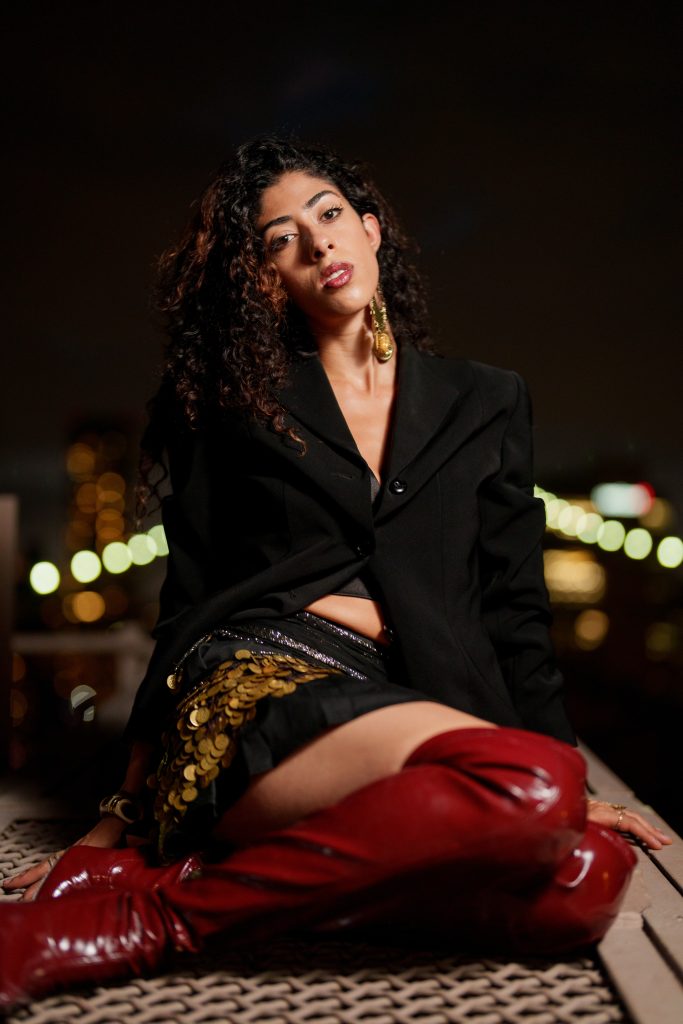
Felukah: ‘Btwhashni’ is all in Arabic– that was a big thing for me, it’s the access point that which people can understand the song. It’s really for people back home, who don’t really have women singing or rapping on tracks like this. This kind of music really liberates me. I’m on a beach in Costa Rica in my mind, I’m wearing a traditional belly dance outfit, and I’m the talk of the town. And that’s how I see this world. It’s like a fantasy land where all my girls are empowered. We’re dancing. We’re not weighed down by shame– shame culture is eradicated period.
It’s just a futuristic vision for me. I don’t really see a point in creating if I’m not creating a blueprint for the future, opening spaces for women like me. But then again, of course, music knows no gender. I would love for this music to inspire anybody, but really focusing on our girls and our women has always been a priority for me.
Credits: Shanaz Deen
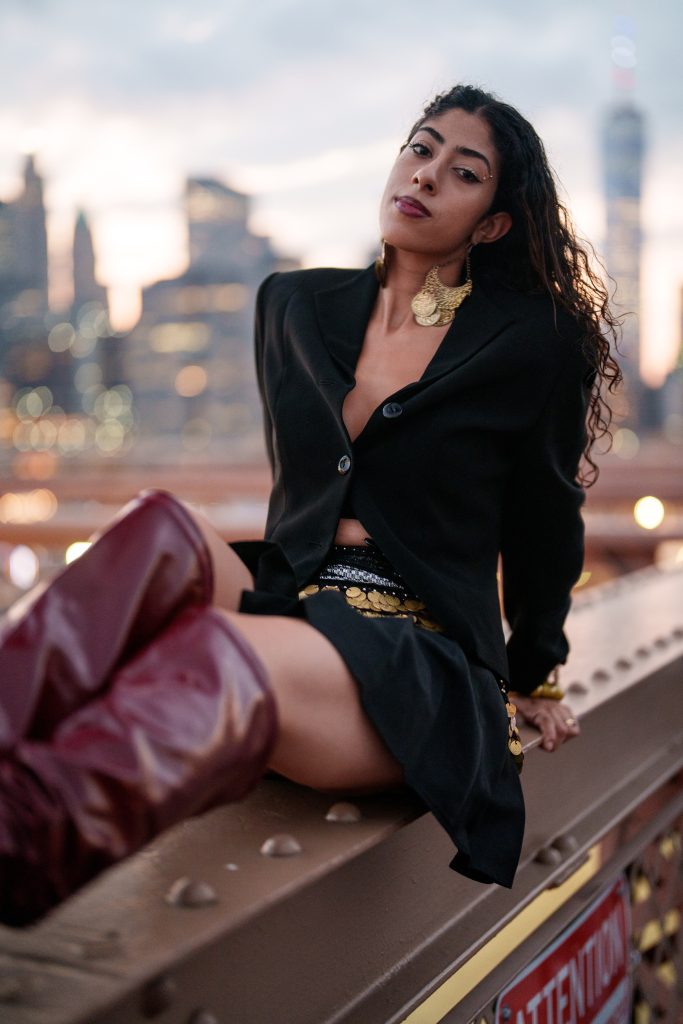
Cosmo ME: Your Boiler Room performance at the Brooklyn Mirage was a big moment in your career. How did it feel to perform songs from ‘Harara’ in front of such a hype crowd, and what were some memorable moments from that night?
Felukah: Wallahi, Boiler Room is called Boiler Room for a reason. I was sweating my weight– it was just insane. It was the hottest room I’ve ever performed in– the 360 crowd has a different experience. It felt like I was in a boxing ring that everybody danced in around me, there was hardly any space to breathe, let alone dance and exist in. But that made it all the more exciting because I felt like the room was really just hanging on everywhere at every beat.
I think the most distinct moment was when ‘Batwanes Beek’ came on and the sample started, the drums came in, and people just went crazy for it. ‘Btwhashni’ and ‘Dance With Me’ also went crazy. For me, it’s the visual of seeing arms flailing around, when I see that, and it does happen with the dance tracks, I’m like okay we’re gonna go crazy, we’re about to take off.

Credits: Shanaz Deen
Cosmo ME: What’s next for Felukah?
Felukah: I started recording an audiobook of my collection of poetry with my brother, who is more of a classical musician. Lana Del Ray has this audiobook that she recorded as well, with stripped-back instrumentals of her poems. I thought that was really profound to create a project with poetry sung by one of your favorite artists. I feel like hip-hop is calling me strong and people know me for it. So, I’m excited to come home.
Listen to Felukah’s EP here.
Interview by Sara Ibrahim.