
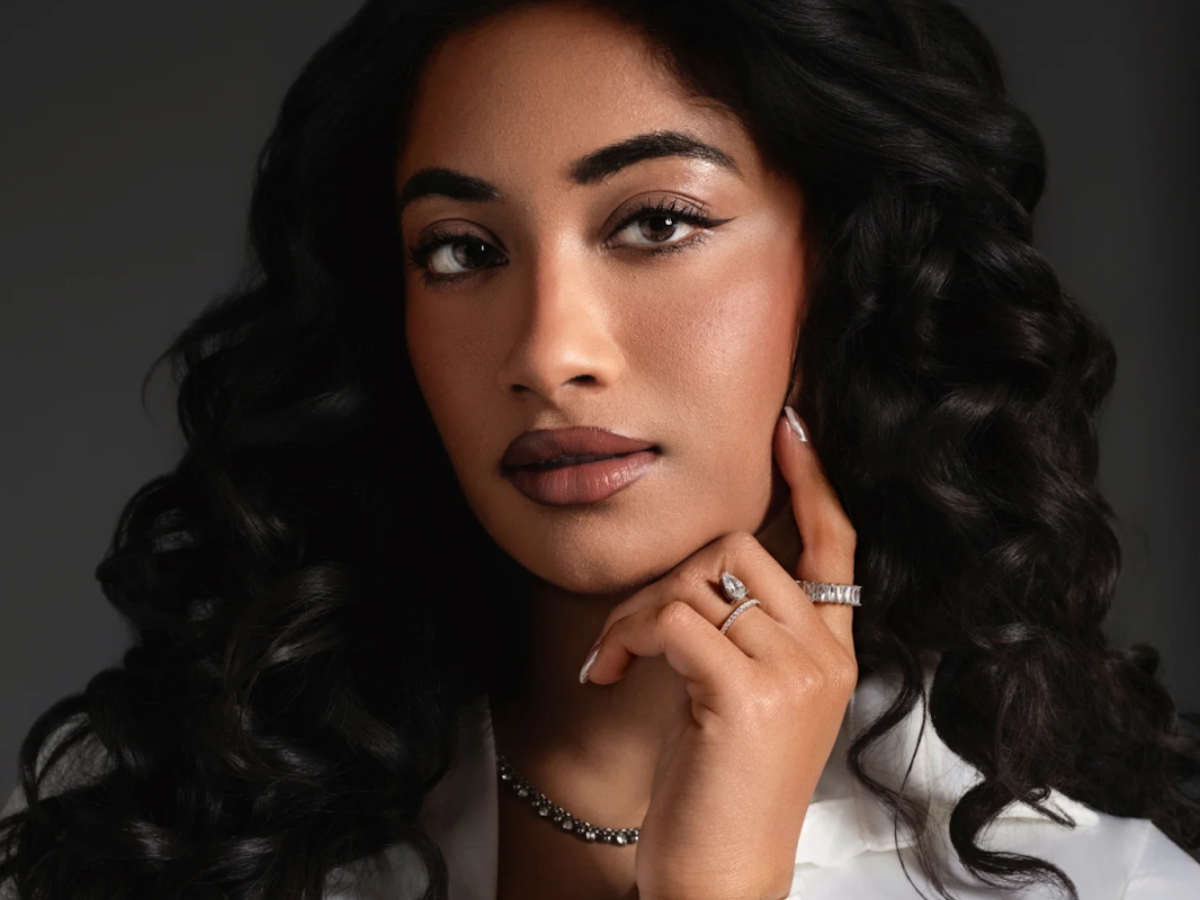

Monica Ravichandran didn’t set out to become one of beauty’s most influential voices; she set out to solve a problem. A former engineer and product manager with 2.3 million followers and over 70 million monthly viewers, she built her platform on rigour and colour theory. She is best known as the creator behind the viral Lipstick Colour Theory movement, which reshaped how consumers understand undertones and exposed why traditional “inclusive” shade ranges often fall short for brown skinned girls. A former product manager and engineer, Monica applies data and colour theory to beauty education. That rigour has now translated directly into product. Monica co-developed a cushion foundation with Espoir, one of Korea’s oldest makeup brands and one of the first in K-beauty to collaborate with a South Asian creator, introducing four olive shades entirely new to the market, and launched a Lip and Liner Duo with fwee, developed to address the shade payoff gaps that deeper and olive skin tones have long been failed by. Monica represents a broader and necessary shift in beauty. We chat with her to dig deeper.
CosmoME: How does it feel to look back at the gap you identified in the beauty world and the impact you’ve had on brown women?
Monica: It feels validating in a way I didn’t expect. When I started, I wasn’t trying to build a movement; I was just frustrated and experiencing the same problems as my community and audience. I couldn’t find honest reviews for my skin tone range , and every ‘universal’ shade recommendation felt written for someone who looked nothing like me. The gap was so obvious to me because I was living it. Now, when I hear from brown girls and women of color who comment, ‘I finally found my shade because of you,’ my hard work feels seen, and that little girl who didn’t grow up with anyone who looked like me in the media feels finally healed.
CosmoME: How has your engineering background shaped your approach to beauty?
Monica: My engineering brain made me approach beauty in a very problem solving way. When a brand says a foundation is ‘for all skin tones,’ I want the data explaining why it works for “all skin tones”.That analytical lens also applies to my content – I use that same problem solving mindset to create content that fills gaps in the social media space. Does the industry need more women challenging it scientifically? Absolutely. But I’d go further: it needs more women of color doing it, because we’re the ones who’ve been failed by the ‘good enough’ standard the longest.
CosmoME: What does the Espoir collaboration mean to you personally, and what message does it send to women with olive undertones?
Monica: This one is personal in a way that’s hard to put into words neatly. Olive-toned women have been told for years that they are “tricky” or “too niche”. Espoir recognised that and wanted to work with me to fill the market gap. Coming out with 4 shades with them was truly a dream come true for me as an olive-skinned woman, but also for so many more olive-toned women who are always struggling to find their shade. Partnering with a leading Korean beauty brand on this shows enormous global influence. If they center us, that sends a message to the whole industry. The Fair olive shade sold out on Amazon within 48 hours, which indicates that this collaboration was NEEDED. I think this sends the message that olive-toned women are SEEN and deserve to be included.
CosmoME: What or who inspired you with the beauty development process?
Monica: What keeps me going is honestly my community. When I’m in a back and forth with a brand over why a shade is pulling too orange on deeper skin, I think about the girl who will buy that product and trust it. She deserves for someone to have fought for her before it hit the shelf.
As for the women who’ve shaped me, my mom is the first one. She modelled what it looks like to be precise, to care deeply, and to not shrink. And then there’s my audience, genuinely. A million women showing up and saying ‘me too’ is not just motivation, it’s accountability.
CosmoME: What does the future look like for you, and what would you say to a young South Asian woman who hasn’t yet found her shade?
Monica: The future to me looks like more innovation, more proof, and less asking for permission. I’m an engineer who became a beauty creator and is now helping shape formulations, that’s not a straight line, and I’m proud of that. To the young South Asian woman watching: your frustration is data. It means the gap is real, and that makes you the most qualified person to fill it. You don’t have to have a beauty degree or a massive platform to start. You just have to be specific about what you’re missing and stubborn enough to not accept ‘close enough.’ Your shade exists. Go find it, and if it doesn’t exist, build it.