
A few years ago, if anyone asked me where I was from, my mind would split between the country I was born in and the place that raised me. For many of us who grew up here, home was never a single point on a map. It lived in school corridors filled with different accents, in weekend rituals split between cultures, and in the constant feeling of never being quite “Sri Lankan enough,” or somehow being “too Sri Lankan” at the same time.
For third culture kids like me, raised in this in-between space, identity was never fixed. Growing up Lankan in Qatar taught me early on that identity could be fluid. Caught between Sri Lanka’s shores and Qatar’s sand dunes, I learned that roots could travel – shaped not just by where you’re from, but by where you grow.
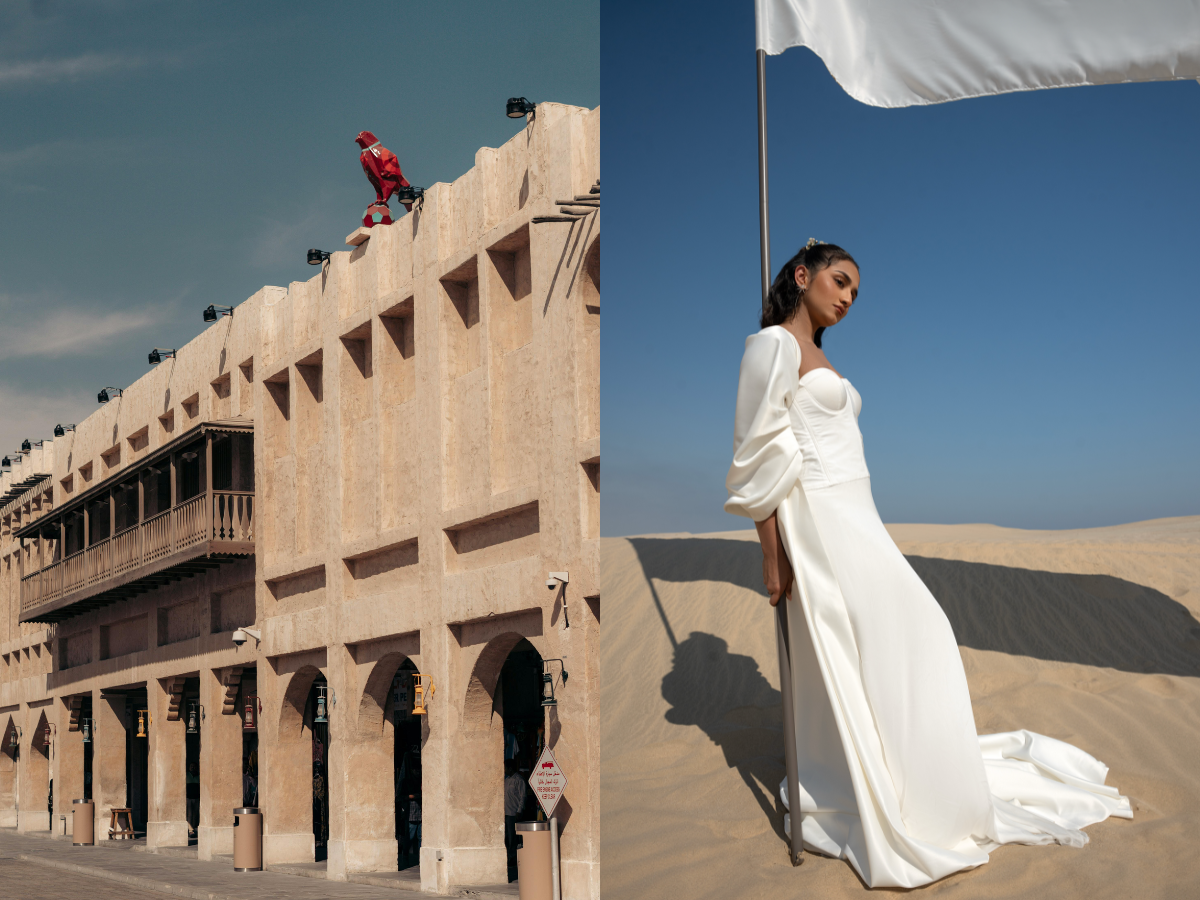
And those identities weren’t formed in isolation. They were shaped by the spaces we moved through every day. I remember walking through Souq Waqif with a grin stretching from cheek to cheek. Beyond the excitement, there was something I couldn’t quite name at the time – a quiet sense of belonging to a culture that wasn’t technically mine. The coffee wasn’t mine. The music wasn’t mine. And yet, it all felt familiar.
I found it ironic how one of the most culturally native spaces in Qatar was one of the places where I felt most at home. With its mud-brick walls and winding alleys, Souq Waqif is deeply rooted in tradition and memory – yet open enough to hold people like us, standing somewhere in between.
I didn’t have the words for it growing up, but now I see it clearly in creatives who, like me, navigated these in-between spaces and learned to turn that experience into art and expression.
Turning roots into rhythm
For Aanji, a Sri Lankan singer, designer, and creative based in Doha, that same layered upbringing became a source of clarity rather than confusion. Growing up Sri Lankan in Qatar, she describes her identity not as split between two cultures, but shaped by many. “My childhood wasn’t defined by just two identities,” she says. “It was an entire mosaic of influences.”

Like many of us, her home life was grounded in Sri Lankan tradition – language, values, and cultural pride, while her world outside was shaped by Qatar’s multicultural rhythm. There were moments of feeling lost between cultures, she admits, but over time, that space became a strength. “Instead of seeing it as a loss, I came to see it as a privilege.”
That perspective shows up clearly in her work. Both of her songs carry subtle Arabic-inspired rhythms, and her music videos were intentionally filmed in Qatar. “I wanted to make it clear that although I’m Sri Lankan, Qatar is also home for me,” she says. Watching people connect with her music across languages and cultures only reinforced something I’d felt for years – that growing up here teaches you how to communicate beyond borders, even when words fall short.
Making space for the in-between
Aanji’s story isn’t singular. It echoes across a wider generation of creatives who grew up navigating multiple identities while learning how to turn that tension into something tangible.
Founded by Lebanese friends Tasha Saradar and Lea Al Chaa, Tash and Ley is a creative platform shaped by contrast – not just in discipline, but in lived experience. One comes from finance, the other from art and design, yet their collaboration grew from a shared desire to create an artistic space that felt open, expressive, and unboxed.

What drew me to their work was how familiar that tension felt. Growing up here, we learnt early that identity doesn’t arrive fully formed. It’s something you build over time, often shaped by the people and cultures around you. For Tasha and Lea, that process was deeply influenced by life in Qatar, growing up surrounded by overlapping perspectives and ways of being.
“As a Lebanese expat, I didn’t feel tied to just one identity,” Tasha shares. “That sense of being in-between became a space of curiosity rather than confusion and where my love for visual expression and experimentation began.”
Together, they see themselves as part of a growing generation of young creatives in Doha who feel increasingly supported to exist outside a single mould. One that respects heritage, but leaves room for reinterpretation.
“Where are you from?”
Initiatives like Thread of Identity at M7 capture exactly why that question is never simple. The project invites participants to design personal motifs reflecting their sense of self, heritage, and community. For those of us raised between cultures, it feels especially familiar. Identity was never singular, but something woven from multiple threads that hold us together.
And that’s what makes Qatar home. Not because it’s where I was born, but because it’s where I learned to belong across worlds. Ma salaamah to the part of me that felt constrained. Here, I found space to stretch, to grow, and to carry every piece of myself with pride.