
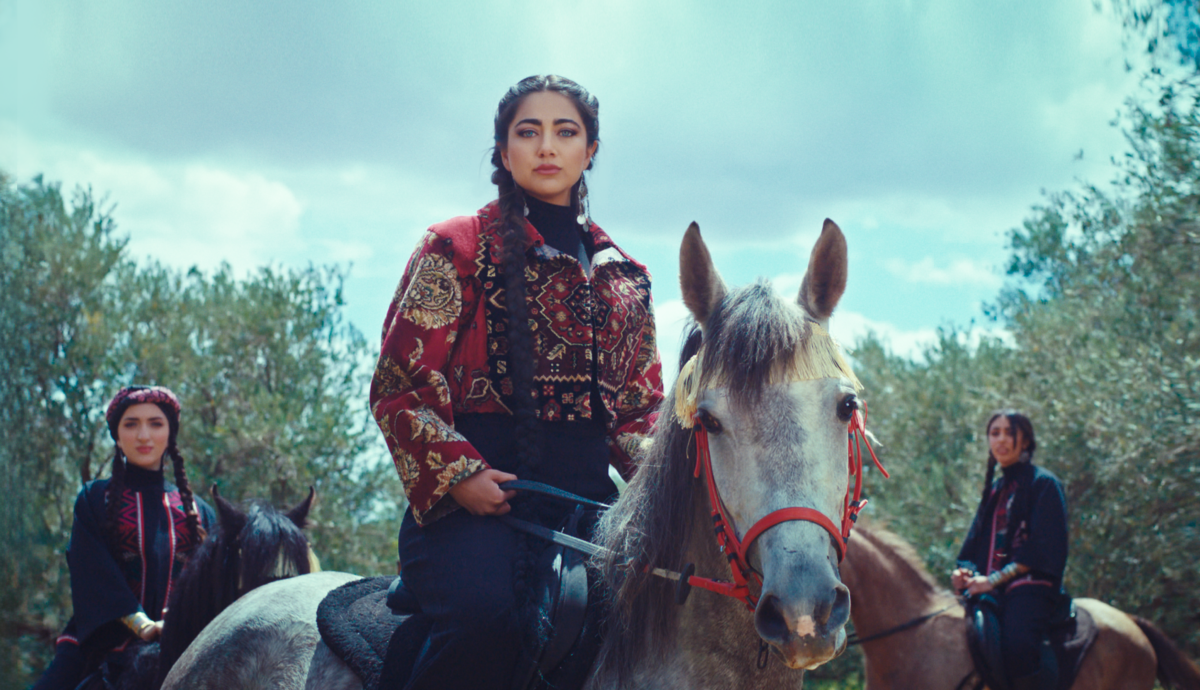
When Palestinian-Jordanian artist Dana Salah calls herself bent bladak (“hometown girl”), it’s more than a lyric—it’s a declaration.
For Palestinian people who are living under occupation, their ties to identity and homeland are visceral. And for Palestinian women, that connection comes with a gendered story.
Co-written and co-directed by Dana herself, Bent Bladak is a story about cultural perseverance. Dana is “just a girl”, wearing bridal henna in one scene, yet riding horses through sacred land like a warrior in another scene.

She draws from tarweedeh, a traditional form of vocal protest. Yes, our girl is flirty and revolutionary.
She pays tribute to generations of Palestinian women while pushing back against cultural erasure. Every detail is intentional: she casts Palestinian refugees, adorns herself in jewellery crafted by Avizeh, an Afghan brand that works with Afghani women and refugees in Pakistan, and spotlights celebratory women performing ancestral Palestinian dance known as dabke.
Dana’s viral track Ya Tal3een marked a cultural turning point, leading to performances on global stages, including two for Sheikha Moza in Qatar. Her shows have become ritual spaces of healing and womanhood in cities like London and Amsterdam.
As the ‘Falahi Pop’ princess, she promises to honour the feminine in different forms. Both Palestinian women and the earth have endured unimaginable pain, but are still standing and even dancing despite the siege.
“Something in my soul ties me to these women,” Dana says. “Whether through generational memory or something deeper, ‘Bent Bladak’ is my offering to them.”
Click here to read our 2024 interview with Dana.