
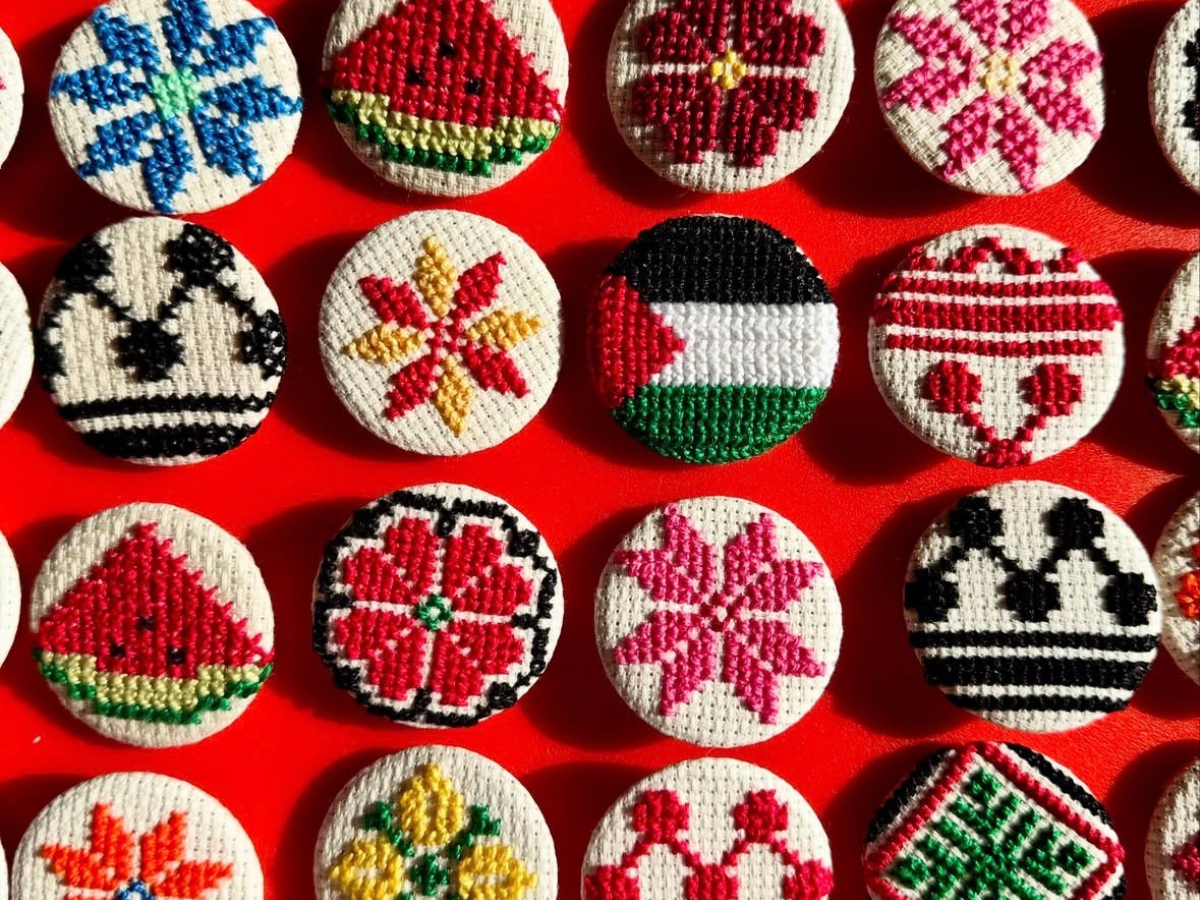

If you’ve noticed complex, geometric embroidery on everything from bridal gowns to streetwear, you may be wondering what exactly that design is.
Well, we’ve got you covered. What you’re seeing is tatreez, a traditional Palestinian embroidery craft, and it’s time it got its flowers.
What tatreez actually is
Tatreez (Arabic for “embroidery”) is a traditional Palestinian and Levantine hand-stitching art form that dates back over 3,000 years to the Canaanite era. Historically, it decorated the thobe, the traditional dress, with motifs representing a woman’s region, social status and personal story.
Every village had its own visual language: specific colours, patterns and techniques that told you exactly where someone was from just by looking at their dress. In 2021, UNESCO recognised its importance by adding tatreez to its Representative List of the Intangible Cultural Heritage of Humanity.
???
Palestinian tatreez https://t.co/GU967BoEkr— Filastin Files™ (@FilastinFiles) April 27, 2026
Every region has its signature
Part of what makes tatreez so rich is just how different it looks depending on where it comes from.
- Ramallah, or the “Red City”, is known for dense, crimson cross-stitch work on white linen. It has motifs like the Saru (cypress tree), which represents life and growth.
- Hebron leans bolder and more architectural, centred around the Khaimeh (tent), a nod to the region’s nomadic history and a symbol of shelter and family.
- Jaffa is the most romantic style, featuring European silk threads and floral motifs like the Zahrat al-Burtuqal (orange blossom), inspired by the city’s citrus groves.
- Gaza is all precision and geometry. It has sharp, controlled patterns like the Muqass (scissors) motif.
- Bethlehem is the most regal of them all, famous for tahriri, a technique using thick gold cord, once kept for the wealthiest families and considered so complex that it only the most senior crafters can do it.
How tatreez is showing up in modern fashion
Today, tatreez has moved firmly into modern fashion, from couture runways to everyday streetwear. You’ll find it on jeans, jackets and T-shirts, as well as accessories like bags, jewellery and shoes. These modern versions keep the craftsmanship visible, carrying the legacy beyond traditional clothing.
Tatreez is really having its moment on the high-fashion stage. GmbH’s Fall-Winter 2025 collection, presented during Berlin Fashion Week and inspired by Gunvor Hofmo’s poem From Another Reality, featured tatreez embroidery. A real moment for Palestinian representation on the runway.
Going a step further, tatreez is having its own museum moment too. The V&A Museum in Dundee, Scotland, had an exhibition from June 26, 2025, to April 26, 2026, called Thread Memory. It was an exhibition focused entirely on a tatreez-heavy wardrobe. Guests could take part in Decorate a Dress, which encouraged people to look at the marks, motifs, shapes, and colours before decorating their own thobe for themselves or someone they love.
You can also find tatreez on the red carpet! At the Golden Globes in January 2026, Saja Kilani wore a custom gown by Jordanian designer Reema Dahbour, inspired by a traditional Palestinian thobe, with tatreez embroidery at the neckline. A true spotlight occasion for the design.
Bridal fashion, in particular, has taken on tatreez’s regional impact. Brides today often choose a motif based on their own family’s roots: a Ramallah Saru for structure and dignity, a Bethlehem Saa’ (sunburst) for something regal and ceremonial, or a Jaffa Asafir (birds) motif for something softer and more romantic.
The placement of the embroidery matters too. For example, picture a bold Hebron Khaimeh border on a veil. Beautiful. Or, to mimic the effect of jewellery, a Gaza Qilada (necklace) motif on a high-neck gown can read as a stunning piece of embroidered jewellery.
Contemporary artists are pushing the craft even further. For instance, Jordan Nassar adds traditional tatreez techniques to textile art, bridging heritage and modern artistic dialogue. Similarly, community initiatives like the Tatreez Collective, founded by Dina Asfour and Yomn Al-Kaisi, run workshops to keep the practice alive and accessible.
Tatreez is Palestinian cross-stitch embroidery passed down by Palestinian women and girls for centuries. Used to decorate thobes (dresses). Every Palestinian town has its own thobe, its own designs.
Tatreez is not just thread or style. It is a story. A map. It is resistance ❤️?? https://t.co/oWobaGPoTY
— Dr Rahmeh Aladwan (@doctor_rahmeh) May 17, 2026
Tatreez is more than decoration
Tatreez isn’t just about looking beautiful; it has always carried meaning. This became even more true after 1948. Palestinian women stitched their villages’ motifs onto keffiyehs, scarves and banners in Lebanon, Syria, Jordan and the West Bank.
Women also began embroidering symbols and maps onto their clothing. This turned the simple act of wearing a thobe into a quiet statement.
Why it matters to get tatreez right
As tatreez grows in popularity, authenticity matters more than ever. Genuine tatreez isn’t just about the visual pattern; it’s about technique: stitching, the right thread, accurate motifs, and fair wages for the artists, often women in refugee communities, who are keeping the craft alive. Choosing pieces made by Palestinians or brands that work directly with embroiderers doesn’t just give you a beautiful, meaningful piece; it directly supports the people preserving this 3,000-year-old art form.
At its best, tatreez turns a garment into a living archive, stitching together memory, identity, and survival into something you can actually wear.
Next, in honour of Pinktober, read where to get a free mammogram across the UAE this October