
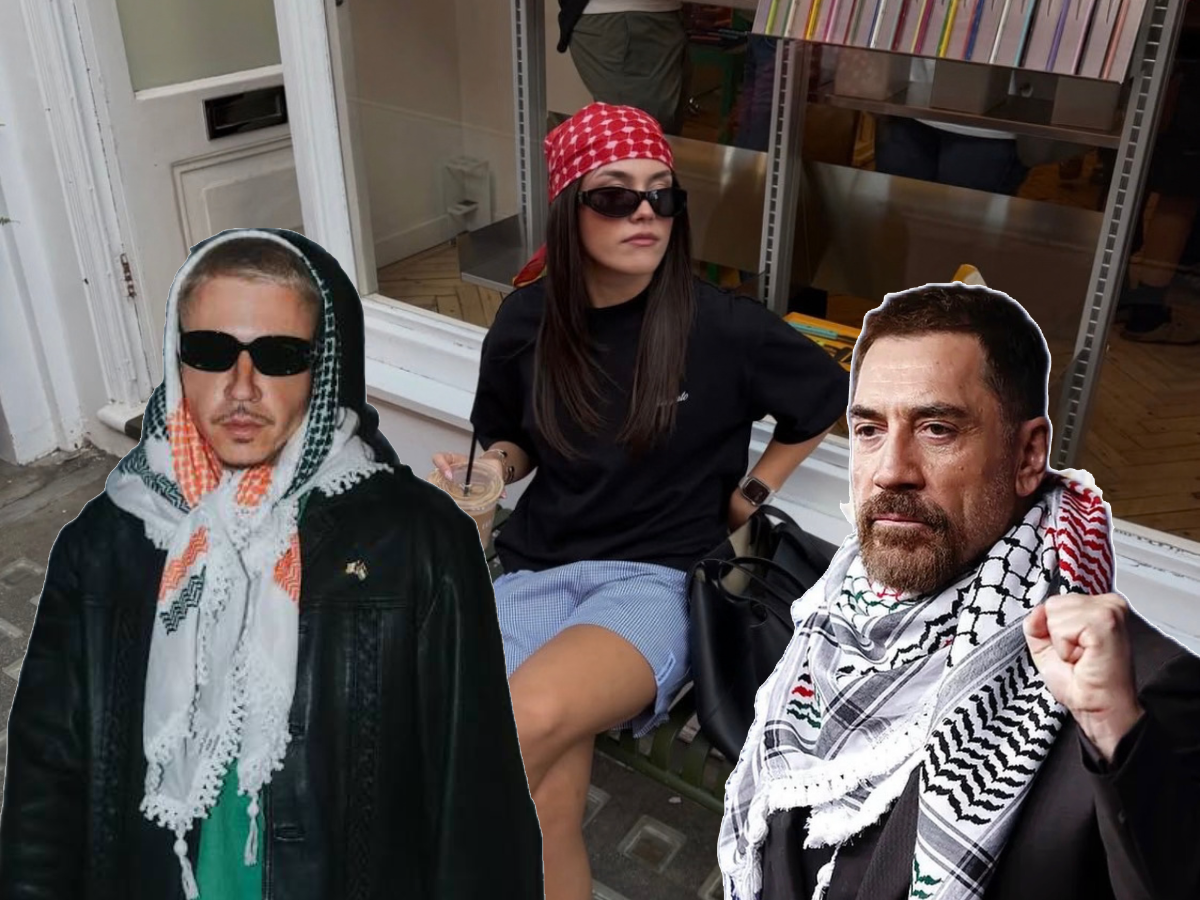

One thing we can’t stop noticing on social media lately is how the keffiyeh has slowly become a global fashion statement.
What was once seen purely as a traditional headscarf has found its way into everyday wardrobes, worn draped over shoulders, knotted around necks, or styled as an accessory to an otherwise simple outfit.
The keffiyeh actually goes by a lot of different names. You might know it as the kufiya, shemagh or hatta. But the Palestinian keffiyeh isn’t just a style statement. It holds deep cultural and political significance, serving for generations as a symbol of Palestinian identity, resistance, freedom and independence.
In general, it is a traditional Arab scarf typically worn as a head covering, recognisable by its distinctive woven patterns. And while the terms are sometimes used interchangeably, the keffiyeh and shemagh actually differ in their traditional uses and construction. The shemagh is generally made from thicker, more durable cotton or wool and is often associated with more rugged or tactical use. The keffiyeh, by contrast, is typically lighter and more loosely woven, making it suited to everyday wear as a scarf or head covering.
Lately, the keffiyeh has simultaneously turned into both a symbol of Palestinian alliance and a fashion statement. It carries history, memory and meaning that stretch back decades.
We’ve put together some of the best ways people have been styling it, including your favourite celebs. Think Macklemore, Saint Levant, and Denny Duquette from Grey’s Anatomy. Here’s how we recommend styling your keffiyeh while keeping in mind what it represents.
A full coverage headdress
For maximum coverage, drape the keffiyeh over your head and shoulders, letting the fabric fall loosely around your face and neck. Knot it at the front. This traditional style protects you from the sun, wind, and dust while keeping the distinctive pattern on full display. Funnily enough, this style is super popular at festivals.
A cross-body wrap
For a more relaxed, effortless look, drape the keffiyeh diagonally across the body, letting one end fall over the opposite shoulder. Super stylish. It’s an easy way to wear the scarf as a statement layer without wrapping it around the neck.
A classic shoulder wrap
Perhaps the trendiest and lowest-effort option. Simply fold the keffiyeh and drape it over both shoulders, allowing the ends to hang evenly at the front. This is one of the easiest ways to incorporate the scarf into an everyday outfit.
If you don’t want it to fall, maybe try knotting the two ends together behind your back.
A tactical face wrap
https://t.co/e2Aw4KWGUm
— saint levant official (@theboyfromgaza) March 12, 2025
You can also wrap the keffiyeh around the lower half of your face, covering your nose and mouth while leaving your eyes exposed. Traditionally practical in dusty or harsh environments, the style also gives the scarf a more rugged feel.
A classic neck wrap
Fold the keffiyeh into a triangle and loosely wrap it around the neck, allowing the ends to sit at the front or fall over one shoulder. It’s a simple, versatile option for both casual and more polished looks.
Around the waist
Our personal favourite? Wrap it around your waist. A bit unconventional, but it looks cute. Wear it over trousers, shorts or a skirt for an easy, statement-making layer.
Hijab head-wrap
You can also style the keffiyeh as a headscarf. Wrap it around your head and neck like a hijab. Depending on the fold and drape you prefer, it can provide fuller coverage or a more relaxed, layered look.
With an Agal
Place the keffiyeh over your head and secure it with an agal—the black cord traditionally worn around the head. This keeps the scarf in place while creating a classic, structured silhouette.
Bandana/Headband
For a casual styling option, fold the keffiyeh into a narrow strip and tie it around the head as a bandana or headband. It keeps hair off your face and elevates an otherwise simple outfit.
From the traditional head wrap to contemporary street-style interpretations, you can wear the keffiyeh in countless ways. The keffiyeh is, above all, a symbol of Palestinian heritage, identity and resistance. It is more than a fashion statement; it carries its history wherever it is worn.
Next, read about the emerging regional brands that are our next obsession!