

Whether you’re looking to understand the region beyond your newsfeed, searching for your next book club obsession, or simply trying to give your doomscrolling thumb a well-deserved break, consider this your sign to pick up a book. From devastating family sagas and sharp political essays to graphic memoirs and swoon-worthy YA fantasy, there’s something here for every kind of reader.
These books explore the Middle East through the people who call it home, those who have been forced to leave, and the generations growing up in the diaspora. They delve into the region’s history, politics, cultures and identities in ways that headlines alone simply can’t. And at a time when reading can feel like another thing competing for our increasingly limited attention, we’re making a case for slowing down, turning a page, and getting lost in a really good story.
Consider this your reading list, your next book club agenda, and your reminder that there’s a whole world waiting beyond your For You Page.
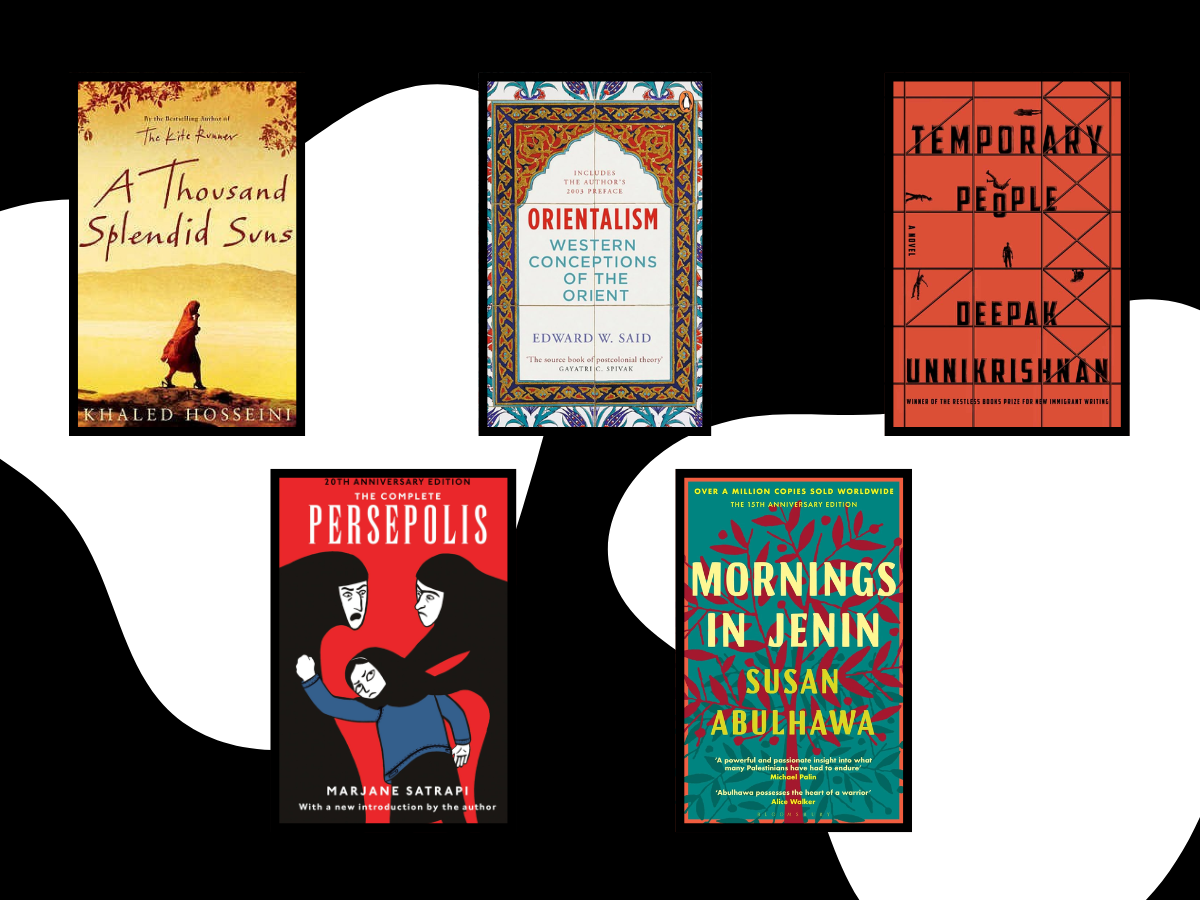
Temporary People – Deepak Unnikrishnan
Dubai’s glittering skyline didn’t build itself, and Deepak Unnikrishnan’s inventive debut gives a voice to the migrant workers whose labour helped shape the Gulf, yet whose stories are so often left out of the picture.
Winner of the Restless Books Prize for New Immigrant Writing, Temporary People is a genre-bending collection of 28 linked stories that blends surrealism, satire and social commentary. Workers transform into pieces of luggage to escape labour camps, while others are engineered to live for exactly 12 years. It’s strange, imaginative and deeply moving, using speculative fiction to explore the realities of displacement, labour and belonging.
More than a conventional novel, it’s a powerful meditation on what it means to build a home in a place that may never fully recognise you as its own.
Orientalism – Edward Said
For anyone who wants to understand how the Middle East has been represented in Western culture, Edward Said’s Orientalism is essential reading. First published in 1978, this landmark work examines how European and American scholarship, literature and political thought constructed an idea of ‘the Orient’ as exotic, irrational and fundamentally different from the West.
Said argues that these representations were never simply neutral observations. They helped reinforce colonial power by presenting Eastern societies as inferior and in need of Western intervention, while sidelining the voices of the people being described.
It’s a challenging read in places, but its central questions remain strikingly relevant: who gets to tell a story, whose perspective becomes the accepted truth, and what happens when an entire region is viewed through someone else’s lens?
If you’ve ever questioned the way the Middle East is portrayed in the media, this is a book that will give you plenty to think about long after you turn the final page.
The Complete Persepolis – Marjane Satrapi
Want a book that manages to be funny, heartbreaking and politically illuminating all at once? The Complete Persepolis delivers all three. This autobiographical graphic memoir follows Marjane Satrapi’s childhood and adolescence in Iran during and after the Islamic Revolution, offering a deeply personal perspective on a period of enormous change.
Told through striking black-and-white illustrations, Satrapi explores political repression, war, family, rebellion and the complicated experience of growing up between personal freedoms and public expectations. Her younger self is funny, outspoken and often wonderfully defiant, making the memoir feel intimate even as it tackles enormous political questions.
It’s also a reminder that people’s lives are never defined by politics alone. There are friendships, embarrassing teenage phases, family arguments and moments of joy, even in the most difficult circumstances.
Accessible without ever feeling simplistic, Persepolis is a brilliant starting point for anyone looking to learn more about modern Iranian history through one person’s lived experience.
As Long As The Lemon Trees Grow – Zoulfa Katouh
Some books make history feel less like a series of dates and more like the lives of the people caught up in it. Zoulfa Katouh’s YA debut does exactly that.
Set during the Syrian revolution, As Long as the Lemon Trees Grow follows Salama, a pharmacy student who begins volunteering at a hospital in Homs as the country descends into violence. As she struggles with grief, fear and the realities of treating the wounded, she faces an impossible question: should she leave Syria to survive, or stay and fight for the place she calls home?
Katouh weaves romance and coming-of-age themes into a story about displacement, trauma and the determination to hold on to hope. At its heart is the very human struggle to imagine a future when the world around you is falling apart.
It’s an emotional read that brings the Syrian revolution into focus through the experiences of one young woman, making it particularly powerful for readers who want to understand the human cost of conflict.
Mornings In Jenin – Susan Abulhawa
Prepare yourself emotionally before opening Mornings in Jenin. Susan Abulhawa’s multigenerational novel follows a Palestinian family across decades of displacement, tracing their lives from Ein Hod and Jenin to Jerusalem, Lebanon and eventually the United States.
Through the family’s experiences, Abulhawa explores the lasting effects of living in Palestine and the struggle to maintain a connection to home across generations. The novel moves between sweeping historical events and intimate moments of family life, showing how political upheaval shapes everything from personal relationships to a sense of identity.
It’s devastating, but it’s also filled with humanity, tenderness and an enduring attachment to Palestine. Rather than allowing its characters to be reduced to the circumstances they endure, the novel gives them complex inner lives, memories and hopes of their own.
If you’re looking for a book that explores Palestinian history through the people who live it, Mornings in Jenin is a moving place to start.
Veiled Threat – Nadine Asbali
What happens when something as personal as deciding to wear the hijab changes the way the world sees you? In Veiled Threat, Nadine Asbali examines this question through a combination of memoir and political commentary.
Asbali reflects on how wearing the hijab as a mixed-race teenager changed her experience of being perceived in Britain. Once able to pass as ‘white(ish)’, she found herself navigating new assumptions about her identity, faith and place in a country she had always called home.
The book challenges Islamophobia, the scrutiny of Muslim women’s bodies and the paternalistic attitudes that can appear even within feminist spaces. Asbali draws on her personal experiences to question who gets to define liberation, and why visibly Muslim women are so often spoken about rather than listened to.
Sharp, personal and unapologetic, Veiled Threat is a compelling read for anyone interested in the intersections of faith, race, gender and belonging.
The Stationery Shop of Tehran – Marjan Kamali
For the romantics among us, The Stationery Shop of Tehran is a reminder that love stories can be about far more than two people finding each other. Set in Tehran in 1953, Marjan Kamali’s novel follows Roya, a young woman who falls for Bahman, a passionate supporter of political change, after meeting him in a stationery shop filled with books, ink and fountain pens.
Their relationship blossoms against a backdrop of growing political unrest, until a sudden separation changes the course of both their lives. Spanning decades and continents, the novel explores what happens when history intervenes in a love story, leaving two people to wonder about the lives they might have shared.
It’s a tender, bittersweet tale of memory, missed chances and the way political events can shape even the most private corners of our lives.
Romance lovers, keep the tissues nearby. This one might just leave you thinking about your own what-ifs.
We Hunt The Flame – Hafsah Faizal
Not every Middle Eastern-inspired read needs to leave you emotionally devastated. If you’d rather escape into another world entirely, Hafsah Faizal’s We Hunt the Flame is a YA fantasy worth adding to your shelf.
Set in Arawiya, a richly imagined world inspired by ancient Arabia, the novel follows Zafira, a young woman who disguises herself as a man to hunt and provide for her people, and Nasir, the feared Prince of Death, who is sent to stop her. Both have become legends in their own right, but neither is entirely comfortable with the roles they’ve been forced to play.
As an ancient threat grows and a dangerous quest unfolds, their paths collide in a story filled with magic, political intrigue, shifting loyalties and a slow-burn enemies-to-lovers romance.
With its world-building, complex characters and exploration of identity, We Hunt the Flame offers a fantasy adventure that draws on Arabian-inspired settings while giving its young protagonists room to challenge expectations and define themselves.
Whatever your interest, there is a book for it. Whether it be a YA, graphic novel, romance, or tear-jerker — there is something for everyone. Consider this your sign to get reading and stop doom-scrolling.
Next, read all the best places to cry it out in Dubai!