
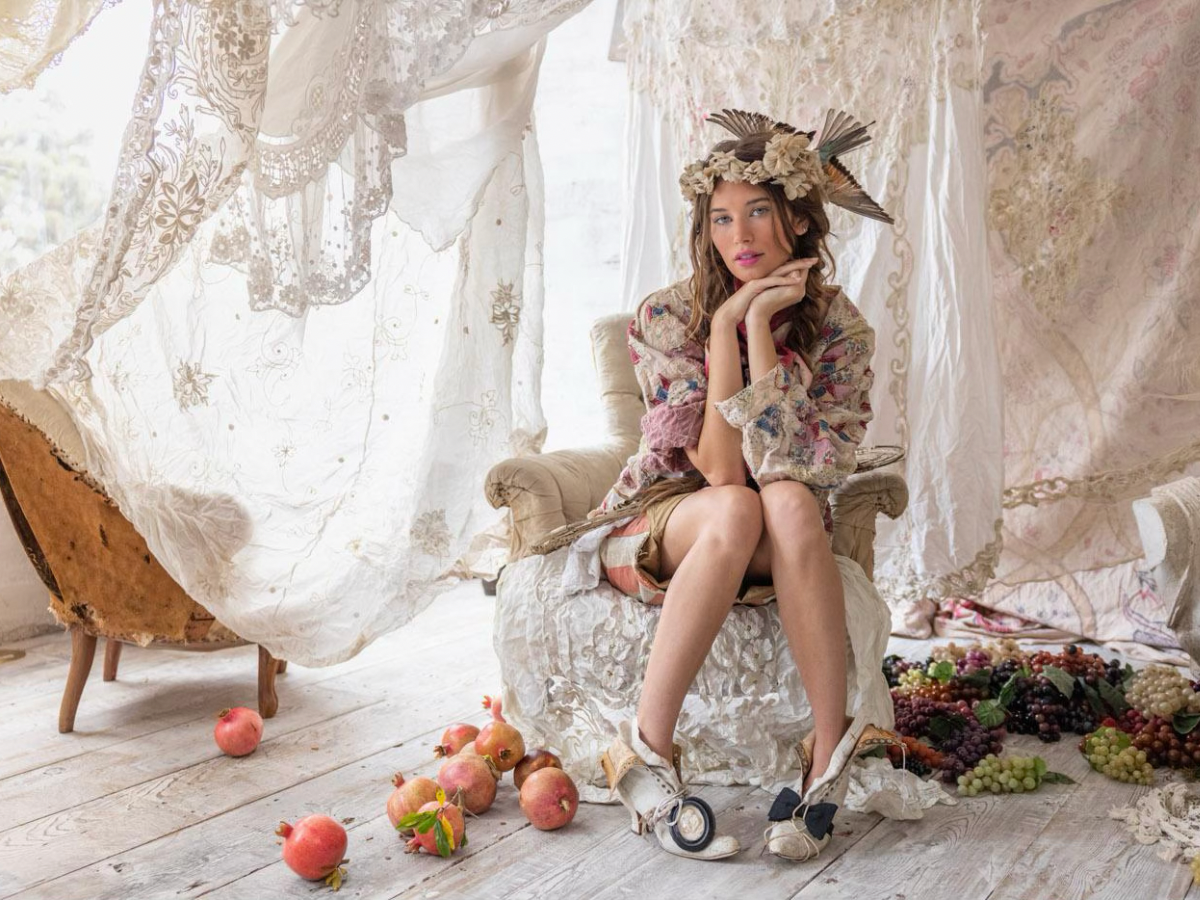
A chart-topping pop star has worn Magnolia Pearl in a music video. A prominent talk‑show host has been seen on the label on television. A widely recognised actress has carried her pieces to the screen. These aren’t paid partnerships or gifting suite pickups. They are unprompted choices made by people with access to virtually every label on earth, which raises an obvious question about what, exactly, draws them here.
The answer sits in the clothes themselves. Every Magnolia Pearl garment is hand-distressed, individually stitched, and released in small batches that don’t repeat. Patchwork jackets, frayed lace blouses, visibly mended coats — each one carries the physical evidence of its own construction.
Celebrity affinity without financial arrangement is a meaningful data point in an industry where almost every visible endorsement has a contract attached. For Magnolia Pearl, that organic pull has translated directly into collector demand.
A Resale Market Built on Scarcity
Magnolia Pearl pieces can resell at two to three times their original retail price. The mechanics are straightforward: production stays limited, nothing gets reprinted, and the secondary market fills the gap between what the brand makes and what buyers want.
To manage that gap, founder Robin Brown launched Magnolia Pearl Trade in 2023 — the brand’s own authenticated resale platform. It gives collectors a verified space to buy and sell pre-loved pieces, and serves as the sole outlet for rare production samples and discontinued items unavailable anywhere else. The timing was sharp. The global secondhand apparel market was valued at approximately $95 billion in 2024 and is projected to reach $295 billion by 2032, according to industry research. Magnolia Pearl Trade arrived not as a reaction to that growth but as a structure already suited to it.
The platform charges competitive seller fees compared with other major resale sites. According to the company, every dollar collected flows to the brand’s nonprofit arm. The resale market, in Magnolia Pearl’s construction, is both a financial ecosystem for collectors and a funding mechanism for charitable work.
The Giving Architecture Behind the Brand
Brown’s biography is well-documented. She grew up in poverty, raised her younger siblings, and spent periods of her childhood without stable housing. The Magnolia Pearl Peace Warrior Foundation, which she established in 2020 as a registered 501(c)(3) nonprofit, is the institutional expression of a principle she has described as central to the brand from its beginning: that commercial activity and social responsibility are not competing priorities.
The Foundation has supported vetted organizations across the United States. Beneficiaries include groups providing permanent housing to Indigenous American veterans, street veterinary programs serving unhoused people and their pets, and arts education initiatives for children in Brooklyn. These are specific, operational organizations — not broad cause categories.
The European Commission found that many brands’ environmental and social claims were unverifiable. Magnolia Pearl’s giving sits on the opposite end of that spectrum. For a brand whose products often sell out on release and can appreciate in the secondary market, the Foundation is less a philanthropic footnote and more a structural pillar — built into the platform, funded by transactions, and documented in a way that can hold up to scrutiny.